Sabtu, 12 Maret 2016

King Louis XVI


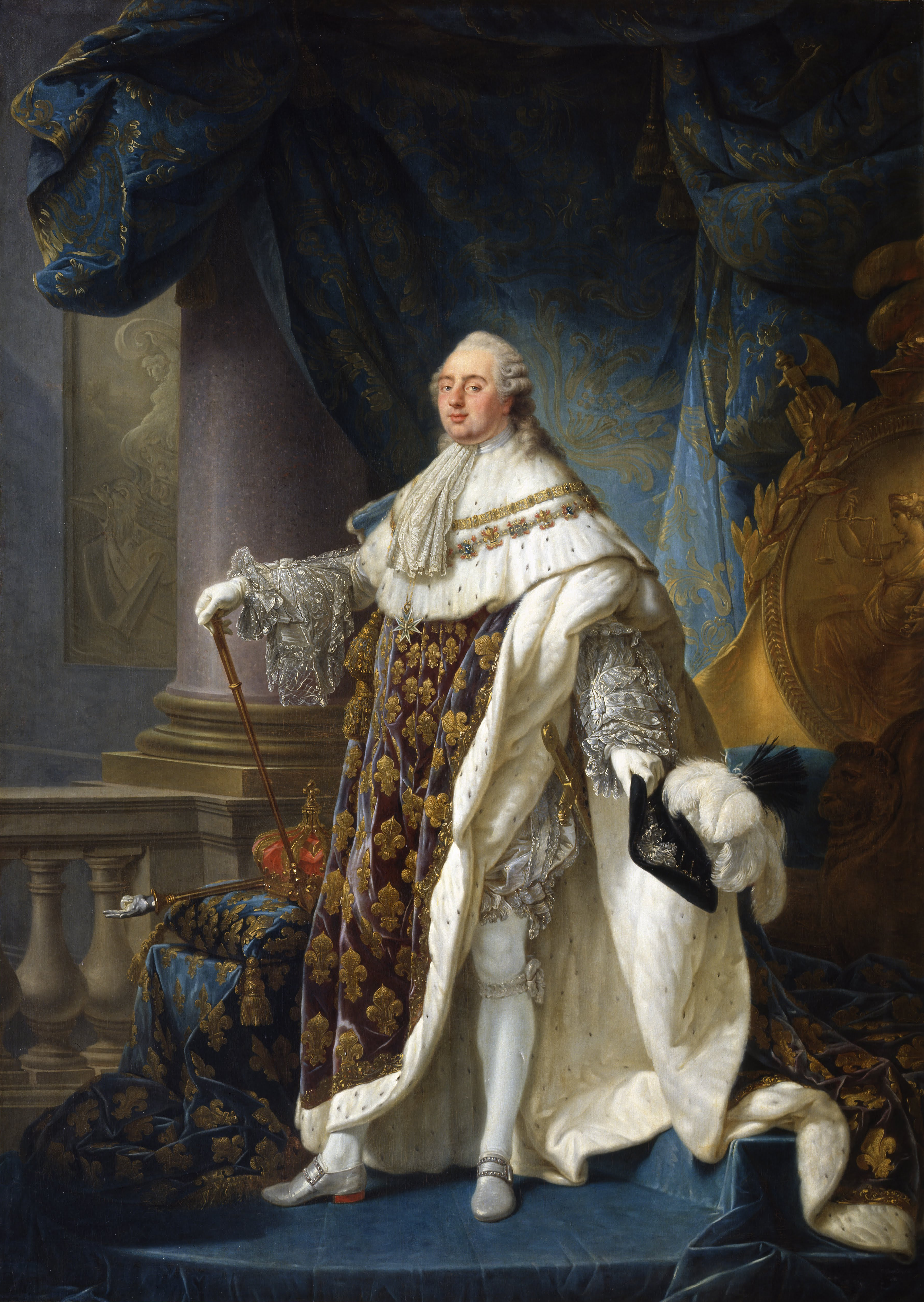
Louis XVI 23 August 1754 – 21 January 1793), born Louis-Auguste, also known as Louis Capet was King of France from 1774 until his deposition in 1792, although his formal title after 1791 was King of the French. He was guillotined on January 21, 1793. His father, Louis, Dauphin of France, was the son and heir apparent of Louis XV of France, but his father died in 1765, and Louis succeeded his grandfather as king in 1774.
The first part of Louis' reign was marked by attempts to reform France in accordance with Enlightenment ideals. These included efforts to abolish serfdom, remove the taille, and increase tolerance toward non-Catholics. The French nobility reacted to the proposed reforms with hostility, and successfully opposed their implementation. Louis implemented deregulation of the grain market, advocated by his liberal minister Turgot, but it resulted in an increase in bread prices. In period of bad harvests, it would lead to food scarcity which would prompt the masses to revolt. From 1776 Louis XVI actively supported the North American colonists, who were seeking their independence from Great Britain, which was realized in the 1783 Treaty of Paris.
The ensuing debt and financial crisis contributed to the unpopularity of the Ancien Régime which culminated at the Estates-General of 1789. Discontent among the members of France's middle and lower classes resulted in strengthened opposition to the French aristocracy and to the absolute monarchy, of which Louis and his wife, queen Marie Antoinette, were viewed as representatives. In 1789, the storming of the Bastille during riots in Paris marked the beginning of the French Revolution.
Louis's indecisiveness and conservatism led some elements of the people of France to view him as a symbol of the perceived tyranny of the Ancien Régime, and his popularity deteriorated progressively. His disastrous flight to Varennes in June 1791, four months before the constitutional monarchy was declared, seemed to justify the rumors that the king tied his hopes of political salvation to the prospects of foreign invasion. The credibility of the king was deeply undermined and the abolition of the monarchy and the establishment of a republic became an ever increasing possibility.
In a context of civil and international war, Louis XVI was suspended and arrested at the time of the insurrection of 10 August 1792 one month before the constitutional monarchy was abolished and the First French Republic proclaimed on 21 September 1792. He was tried by the National Convention (self-instituted as a tribunal for the occasion), found guilty of high treason, and executed by guillotine on 21 January 1793, as a desacralized French citizen known as "Citizen Louis Capet", a nickname in reference to Hugh Capet, the founder of the Capetian dynasty – which the revolutionaries interpreted as Louis' family name. Louis XVI was the only King of France ever to be executed, and his death brought an end to more than a thousand years of continuous French monarchy.

Child Hood
Louis-Auguste de France, who was given the title Duc de Berry at birth, was born in the Palace of Versailles. Out of seven children, he was the second son of Louis, the Dauphin of France, and thus the grandson of Louis XV of France and of his consort, Maria Leszczyńska. His mother was Marie-Josèphe of Saxony, the daughter of Frederick Augustus II of Saxony, Prince-Elector of Saxony and King of Poland.
Louis-Auguste had a difficult childhood because his parents neglected him in favour of his, said to be, bright and handsome older brother, Louis, duc de Bourgogne, who died at the age of nine in 1761. A strong and healthy boy, but very shy, Louis-Auguste excelled in his studies and had a strong taste for Latin, history, geography, and astronomy, and became fluent in Italian and English. He enjoyed physical activities such as hunting with his grandfather, and rough-playing with his younger brothers, Louis-Stanislas, comte de Provence, and Charles-Philippe, comte d'Artois. From an early age, Louis-Auguste had been encouraged in another of his hobbies: locksmithing, which was seen as a 'useful' pursuit for a child.[1]
Upon the death of his father, who died of tuberculosis on 20 December 1765, the eleven-year-old Louis-Auguste became the new Dauphin. His mother never recovered from the loss of her husband, and died on 13 March 1767, also from tuberculosis.[2] The strict and conservative education he received from the Duc de La Vauguyon, "gouverneur des Enfants de France" (governor of the Children of France), from 1760 until his marriage in 1770, did not prepare him for the throne that he was to inherit in 1774 after the death of his grandfather, Louis XV. Throughout his education, Louis-Auguste received a mixture of studies particular to religion, morality, and humanities.[3] His instructors may have also had a good hand in shaping Louis-Auguste into the indecisive king that he became. Abbé Berthier, his instructor, taught him that timidity was a value in strong monarchs, and Abbé Soldini, his confessor, instructed him not to let people read his mind.


King Louis XIV

Louis XIV (5 September 1638 – 1 September 1715), known as Louis the Great (Louis le Grand) or the Sun King (le Roi-Soleil), was a monarch of the House of Bourbon who ruled as King of France from 1643 until his death.[1] His reign of 72 years and 110 days is the longest of any monarch of a major country in European history.[2] In this age of absolutism in Europe, Louis XIV's France was a leader in the growing centralization of power.[3]
Louis began his personal rule of France in 1661 after the death of his chief minister, the Italian Cardinal Mazarin.[4] An adherent of the concept of the divine right of kings, which advocates the divine origin of monarchical rule, Louis continued his predecessors' work of creating a centralized state governed from the capital. He sought to eliminate the remnants of feudalism persisting in parts of France and, by compelling many members of the nobility to inhabit his lavish Palace of Versailles (formerly a hunting lodge belonging to Louis's father), succeeded in pacifying the aristocracy, many members of which had participated in the Fronde rebellion during Louis's minority. By these means he became one of the most powerful French monarchs and consolidated a system of absolute monarchical rule in France that endured until the French Revolution.
During Louis's reign, France was the leading European power and it fought three major wars: the Franco-Dutch War, the War of the League of Augsburg, and the War of the Spanish Succession. There were also two lesser conflicts: the War of Devolution and the War of the Reunions. Louis encouraged and benefited from the work of prominent political, military, and cultural figures such as Mazarin, Colbert, the Grand Condé, Turenne and Vauban, as well as Molière, Racine, Boileau, La Fontaine, Lully, Marais, Le Brun, Rigaud, Bossuet, Le Vau, Mansart, Charles and Claude Perrault, and Le Nôtre.
Upon his death just days before his seventy-seventh birthday, Louis was succeeded by his five-year-old great-grandson, Louis XV. All of his intermediate heirs predeceased him: his son Louis, le Grand Dauphin; the Dauphin's eldest son Louis, Duke of Burgundy; and Burgundy's eldest son Louis, Duke of Brittany (the elder brother of Louis XV).

Early Life
Louis XIV was born on 5 September 1638 in the Château de Saint-Germain-en-Laye to Louis XIII and Anne of Austria. He was named Louis Dieudonné (Louis the God-given)[5] and also bore the traditional title of French heirs apparent: Dauphin.[6] At the time of his birth, his parents had been married for 23 years. His mother had experienced four stillbirths between 1619 and 1631. Leading contemporaries thus regarded him as a divine gift, and his birth a miracle of God.
Sensing imminent death, Louis XIII decided to put his affairs in order in the spring of 1643, when Louis XIV was four years old. In defiance of custom, which would have made Queen Anne the sole Regent of France, he decreed that a regency council would rule on his son's behalf. His lack of faith in Queen Anne's political abilities was the primary reason. He did, however, make the concession of appointing her head of the council.
Louis's relationship with his mother was uncommonly affectionate for the time. Contemporaries and eyewitnesses claimed that the Queen would spend all her time with Louis. Both were greatly interested in food and theatre, and it is highly likely that Louis developed these interests through his close relationship with his mother. This long-lasting and loving relationship can be evidenced by excerpts in Louis's journal entries:
"Nature was responsible for the first knots which tied me to my mother. But attachments formed later by shared qualities of the spirit are far more difficult to break than those formed merely by blood."[7]
It was his mother who gave Louis his belief in the absolute and divine power of his monarchical rule.[8]
In 1646 Nicolas V de Villeroy became the young king's tutor. Louis XIV became friends with his young children, particularly François de Villeroy, and divided his time between the Palais-Royal and the nearby Hotel de Villeroy.

Arc de Triomphe


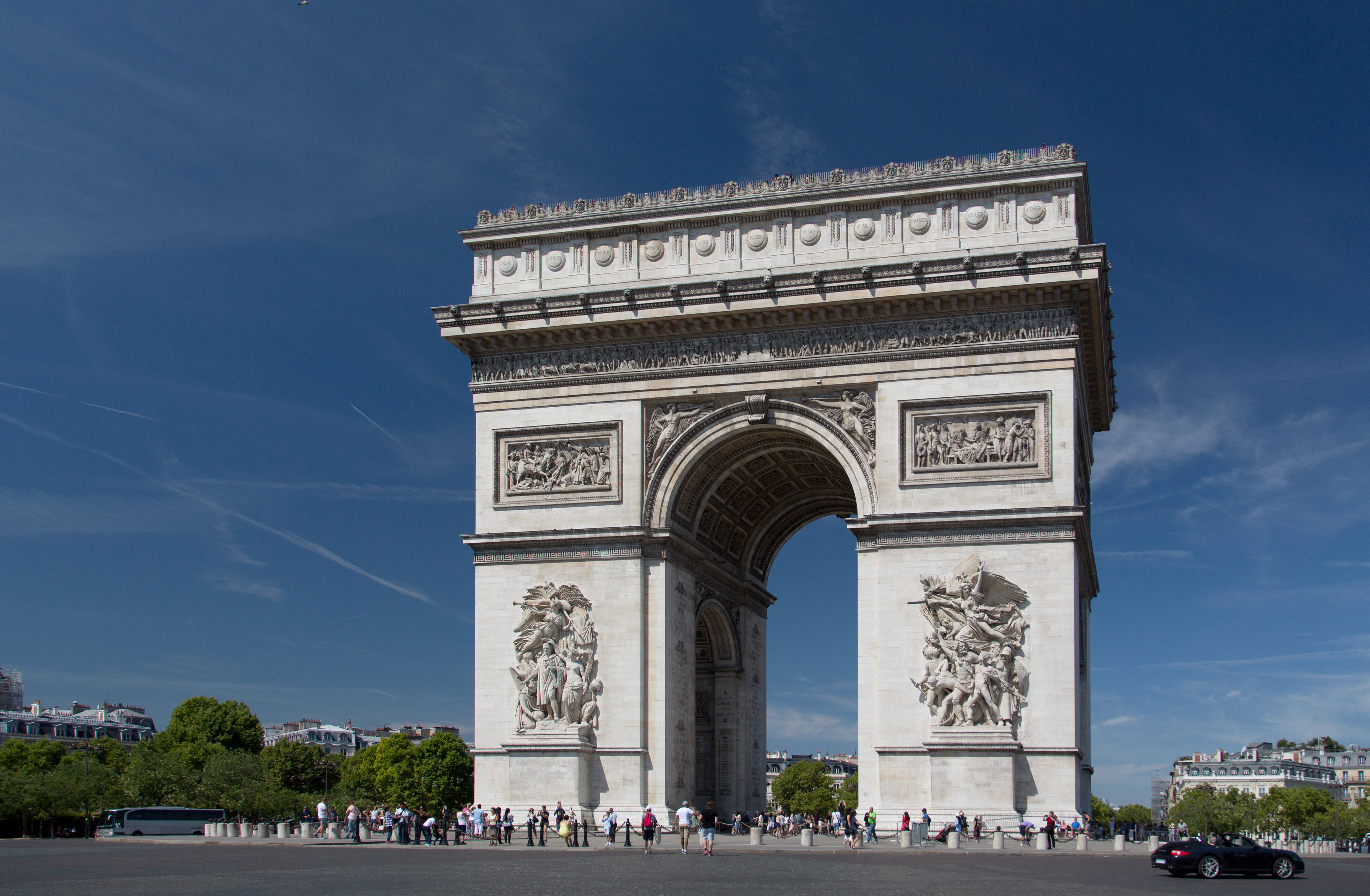
The Arc de Triomphe de l'Étoile, Triumphal Arch of the Star) is one of the most famous monuments in Paris. It stands in the centre of the Place Charles de Gaulle (originally named Place de l'Étoile), at the western end of the Champs-Élysées.[3] It should not be confused with a smaller arch, the Arc de Triomphe du Carrousel, which stands west of the Louvre. The Arc de Triomphe honours those who fought and died for France in the French Revolutionary and the Napoleonic Wars, with the names of all French victories and generals inscribed on its inner and outer surfaces. Beneath its vault lies the Tomb of the Unknown Soldier from World War I.
The Arc de Triomphe is the linchpin of the Axe historique (historic axis) – a sequence of monuments and grand thoroughfares on a route which runs from the courtyard of the Louvre to the Grande Arche de la Défense. The monument was designed by Jean Chalgrin in 1806 and its iconographic program pits heroically nude French youths against bearded Germanic warriors in chain mail. It set the tone for public monuments with triumphant patriotic messages.
The monument stands 50 metres (164 ft) in height, 45 m (148 ft) wide and 22 m (72 ft) deep. The large vault is 29.19 m (95.8 ft) high and 14.62 m (48.0 ft) wide. The small vault is 18.68 m (61.3 ft) high and 8.44 m (27.7 ft) wide. Its design was inspired by the Roman Arch of Titus. The Arc de Triomphe is built on such a large scale that, three weeks after the Paris victory parade in 1919 (marking the end of hostilities in World War I), Charles Godefroy flew his Nieuport biplane through it, with the event captured on newsreel.[4][5][6]
It was the tallest triumphal arch in existence until the completion of the Monumento a la Revolución in Mexico City in 1938, which is 67 metres (220 ft) high. The Arch of Triumph in Pyongyang, completed in 1982, is modelled on the Arc de Triomphe and is slightly taller at 60 m (197 ft).

History
The Arc is located on the right bank of the Seine at the centre of a dodecagonal configuration of twelve radiating avenues. It was commissioned in 1806 after the victory at Austerlitz by Emperor Napoleon at the peak of his fortunes. Laying the foundations alone took two years and, in 1810, when Napoleon entered Paris from the west with his bride Archduchess Marie-Louise of Austria, he had a wooden mock-up of the completed arch constructed. The architect, Jean Chalgrin, died in 1811 and the work was taken over by Jean-Nicolas Huyot. During the Bourbon Restoration, construction was halted and it would not be completed until the reign of King Louis-Philippe, between 1833 and 1836, by the architects Goust, then Huyot, under the direction of Héricart de Thury. On 15 December 1840, brought back to France from Saint Helena, Napoleon's remains passed under it on their way to the Emperor's final resting place at the Invalides.[7] Prior to burial in the Panthéon, the body of Victor Hugo was displayed under the Arc during the night of 22 May 1885.
The sword carried by the Republic in the Marseillaise relief broke off on the day, it is said, that the Battle of Verdun began in 1916. The relief was immediately hidden by tarpaulins to conceal the accident and avoid any undesired ominous interpretations.[8] On 7 August 1919, Charles Godefroy successfully flew his biplane under the Arc.[9] Jean Navarre was the pilot who was tasked to make the flight, but he died on 10 July 1919 when he crashed near Villacoublay while training for the flight.
Following its construction, the Arc de Triomphe became the rallying point of French troops parading after successful military campaigns and for the annual Bastille Day Military Parade. Famous victory marches around or under the Arc have included the Germans in 1871, the French in 1919, the Germans in 1940, and the French and Allies in 1944[10] and 1945. A United States postage stamp of 1945 shows the Arc de Triomphe in the background as victorious American troops march down the Champs-Élysées and U.S. airplanes fly overhead on 29 August 1944. After the interment of the Unknown Soldier, however, all military parades (including the aforementioned post-1919) have avoided marching through the actual arch. The route taken is up to the arch and then around its side, out of respect for the tomb and its symbolism. Both Hitler in 1940 and de Gaulle in 1944 observed this custom.
By the early 1960s, the monument had grown very blackened from coal soot and automobile exhaust, and during 1965–1966 it was cleaned through bleaching.
In the prolongation of the Avenue des Champs-Élysées, a new arch, the Grande Arche de la Défense, was built in 1982, completing the line of monuments that forms Paris's Axe historique. After the Arc de Triomphe du Carrousel and the Arc de Triomphe de l'Étoile, the Grande Arche is the third arch built on the same perspective.
In 1995, the Armed Islamic Group of Algeria placed a bomb near the Arc de Triomphe which wounded 17 people as part of a campaign of bombings 

Charles de Gaulle


Charles André Joseph Marie de Gaulle (French: [ʃaʁl də ɡol]; 22 November 1890 – 9 November 1970) was a French general, resistant, writer and statesman. He was the leader of Free France (1940–44) and the head of the Provisional Government of the French Republic (1944–46). In 1958, he founded the Fifth Republic and was elected as the 18th President of France, until his resignation in 1969. He was the dominant figure of France during the Cold War era and his memory continues to influence French politics.
Born in Lille, he graduated from Saint-Cyr in 1912. He was a decorated officer of the First World War, wounded several times and later taken prisoner at Verdun. He tried to escape with a fellow prisoner, but failed several times. After the war ended, he was released. During the interwar period he advocated mobile armoured divisions. At the beginning of the Second World War, he led an armoured division which counterattacked the invading German army, before being appointed to the French Government as Under-Secretary for War. Refusing to accept his government's armistice with Nazi Germany in 1940, de Gaulle exhorted the French population to resist occupation and to continue the fight against Axis powers in his Appeal of 18 June. He led a government in exile and the Free French Forces against the Axis. Despite frosty relations with Britain and especially the United States, he emerged as the undisputed leader of the French resistance. He became Head of the Provisional Government of the French Republic in June 1944, the interim government of France following its Liberation.[1] As early as 1944, de Gaulle introduced a dirigist economic policy, which included substantial state-directed control over a capitalist economy. It contributed to thirty years of unprecedented growth.[2]
Frustrated by the return of petty partisanship in the new French Fourth Republic, he resigned in early 1946, but continued to be politically active as founder of the RPF Party (Rassemblement du Peuple Français). He retired in the early 1950s and wrote his War Memoirs, which quickly became a classic of modern French literature. When the Algerian war was ripping apart the unstable Fourth Republic, the National Assembly brought him back to power during the May 1958 crisis. De Gaulle founded the Fifth Republic with a strong presidency, and he was elected in the latter role. He managed to keep France together while taking steps to end the war, much to the anger of the Pieds-Noirs (Frenchmen settled in Algeria) and the military; both previously had supported his return to power to maintain colonial rule. He granted independence to Algeria and progressively to other French colonies.
In the context of the Cold War, de Gaulle initiated his "Politics of Grandeur",[3] asserting that France as a major power should not rely on other countries, such as the United States, for its national security and prosperity. To this end, de Gaulle pursued a policy of "national independence" which led him to withdraw from NATO's military integrated command and to launch an independent nuclear development program that made France the fourth nuclear power. He restored cordial Franco-German relations in order to create a European counterweight between the "Anglo-Saxon" (American and British) and Soviet spheres of influence. However, he opposed any development of a supranational Europe, favouring a Europe of sovereign Nations and twice vetoed Britain's entry into the European Community. De Gaulle openly criticised the U.S. intervention in Vietnam[4] and the "exorbitant privilege" of the U.S. dollar,[5] and supported an independent Quebec.[6]
Although re-elected President in 1965, in May 1968 he appeared likely to lose power amid widespread protests by students and workers, but survived the crisis with backing from the Army and won an election with an increased majority in the Assembly. Nonetheless, de Gaulle resigned in 1969 after losing a referendum in which he proposed more decentralization. He died a year later at his residence in Colombey-les-Deux-Églises, leaving his Presidential memoirs unfinished. Many French political parties and figures claim the gaullist legacy.

Early Life
De Gaulle was born in the industrial region of Lille in the Nord departement, the third of five children.[7] He was raised in a family of devout Roman Catholics who were patriotic, royalist and traditionalist and quite progressive. His father, Henri de Gaulle, was a professor of history and literature at a Jesuit college who eventually founded his own school.[8]
His father came from a long line of parliamentary gentry from Normandy and Burgundy, while his mother, Jeanne (née Maillot), descended from a family of wealthy entrepreneurs from Lille. His mother had French, Irish, Scottish, Flemish, and German ancestry.[9][10]
The family lost most of its land in the French Revolution, which it opposed.[11] De Gaulle's father encouraged historical and philosophical debate between his children at mealtimes, and through his encouragement, de Gaulle grew familiar with French history from an early age. Struck by his mother's tale of how she cried as a child when she heard of the French capitulation to the Germans at Sedan in 1870, he developed a keen interest in military strategy and endlessly questioned his father about the other failures of the brief war at Vionville and Mars-la-Tour, and though a naturally shy person his entire life, often organised other children to reenact ancient French battles. The wider de Gaulle family were also very literary and academic, and he was raised on tales of the flight of the Scottish Stuarts to France, to whom he was related on his mother's side. He was also influenced by his uncle, also called Charles de Gaulle, who was a historian and passionate Celticist who wrote books and pamphlets advocating the union of the Welsh, Scots, Irish and Bretons into one people. His grandfather Julien-Philippe was also a historian, and his grandmother Josephine-Marie wrote poems which impassioned his Christian faith.[12][13]
The father inculcated in the son a profound belief in the merit of traditional Catholic France. Charles received a rigorous classical education that included a year 1907–08 at a Jesuit college in Belgium.
By the time he was ten he was reading medieval history, such as the Froissart's Chronicles of the Hundred Years War. De Gaulle began his own writing in his early teens, and later his family paid for a composition, a one-act play in verse about a traveller, to be privately published.[14] Always a voracious reader, he later favored philosophical tomes by such writers as Henri Bergson, Charles Péguy, and Maurice Barrès. In addition to the German philosophers Friedrich Nietzsche, Immanuel Kant and Johann Wolfgang von Goethe, he read the works of the ancient Greeks (especially Plato) and the prose of the romanticist poet François-René de Chateaubriand.[14]
De Gaulle was educated in Paris at the College Stanislas and also briefly in Belgium where he continued to display his interest in reading and studying history and shared the great pride many of his countrymen felt in their nation's achievements. This was not unusual among his peers, who came up in a generation of Frenchmen for whom patriotic and Catholic fervor was rising once again after the long decades of nihilism and anti-clericalism that characterized the post-Revolution country. As he grew older, he also developed a profound belief in his destiny to achieve great things, and, eager to avenge the French defeat of 1870, decided upon a military career as being the best way to make a name for himself. He matriculated at the Saint Cyr military academy in 1908 where he did well; in 1911 he was commissioned in the French army


All About Jeanne d'Arc


Joan of Arc (French: Jeanne d'Arc,[4] IPA: [ʒan daʁk]; 6 January c. 1412[5] – 30 May 1431), nicknamed "The Maid of Orléans" (French: La Pucelle d'Orléans) is considered a heroine of France for her role during the Lancastrian phase of the Hundred Years' War, and was canonized as a Roman Catholic saint. Joan of Arc was born to Jacques d'Arc and Isabelle, a peasant family, at Domrémy in north-east France. Joan said she received visions of the Archangel Michael, Saint Margaret, and Saint Catherine instructing her to support Charles VII and recover France from English domination late in the Hundred Years' War. The uncrowned King Charles VII sent Joan to the siege of Orléans as part of a relief mission. She gained prominence after the siege was lifted only nine days later. Several additional swift victories led to Charles VII's coronation at Reims. This long-awaited event boosted French morale and paved the way for the final French victory.
On 23 May 1430, she was captured at Compiègne by the Burgundian faction which was allied with the English. She was later handed over to the English,[6] and then put on trial by the pro-English Bishop of Beauvais Pierre Cauchon on a variety of charges.[7] After Cauchon declared her guilty she was burned at the stake on 30 May 1431, dying at about nineteen years of age.[8]
Twenty-five years after her execution, an inquisitorial court authorized by Pope Callixtus III examined the trial, debunked the charges against her, pronounced her innocent, and declared her a martyr.[8] In the 16th century she became a symbol of the Catholic League, and in 1803 she was declared a national symbol of France by the decision of Napoleon Bonaparte.[9] She was beatified in 1909 and canonized in 1920. Joan of Arc is one of the nine secondary patron saints of France, along with St. Denis, St. Martin of Tours, St. Louis, St. Michael, St. Remi, St. Petronilla, St. Radegund and St. Thérèse of Lisieux.
Joan of Arc has remained a popular figure in literature, painting, sculpture, and other cultural works since the time of her death, and many famous writers, filmmakers and composers have created works about her. Cultural depictions of her have continued in films, theater, television, video games, music, and performances to this day.

Background
The Hundred Years' War had begun in 1337 as an inheritance dispute over the French throne, interspersed with occasional periods of relative peace. Nearly all the fighting had taken place in France, and the English army's use of chevauchée tactics (destructive "scorched earth" raids) had devastated the economy.[10] The French population had not recovered its original size since the Black Death of the mid-14th century and its merchants were isolated from foreign markets. At the outset of Joan of Arc's appearance, the English had nearly achieved their goal of a dual monarchy under English control and the French army had not achieved any major victories for a generation. In DeVries' words, "The kingdom of France was not even a shadow of its thirteenth-century prototype."[11]
The French king at the time of Joan's birth, Charles VI, suffered from bouts of insanity[12] and was often unable to rule. The king's brother Louis, Duke of Orléans, and the king's cousin John the Fearless, Duke of Burgundy, quarreled over the regency of France and the guardianship of the royal children. This dispute included accusations that Louis was having an extramarital affair with the queen, Isabeau of Bavaria, and allegations that John-the-Fearless kidnapped the royal children.[13] The conflict climaxed with the assassination of the Duke of Orléans in 1407 on the orders of the Duke of Burgundy.[14][15]
The young Charles of Orléans succeeded his father as duke and was placed in the custody of his father-in-law, the Count of Armagnac. Their faction became known as the "Armagnac" faction, and the opposing party led by the Duke of Burgundy was called the "Burgundian faction". Henry V of England took advantage of these internal divisions when he invaded the kingdom in 1415, winning a dramatic victory at Agincourt on October 25 and subsequently capturing many northern French towns.[16] In 1418 Paris was taken by the Burgundians, who massacred the Count of Armagnac and about 2,500 of his followers.[17] The future French king, Charles VII, assumed the title of Dauphin - the heir to the throne - at the age of fourteen, after all four of his older brothers had died in succession.[18] His first significant official act was to conclude a peace treaty with the Duke of Burgundy in 1419. This ended in disaster when Armagnac partisans assassinated John the Fearless during a meeting under Charles's guarantee of protection. The new duke of Burgundy, Philip the Good, blamed Charles for the murder and entered into an alliance with the English. The allied forces conquered large sections of France.[19]
In 1420 the queen of France, Isabeau of Bavaria, signed the Treaty of Troyes, which granted the succession of the French throne to Henry V and his heirs instead of her son Charles. This agreement revived suspicions that the Dauphin may have been the illegitimate product of Isabeau's rumored affair with the late duke of Orléans rather than the son of King Charles VI.[20] Henry V and Charles VI died within two months of each other in 1422, leaving an infant, Henry VI of England, the nominal monarch of both kingdoms. Henry V's brother, John of Lancaster, 1st Duke of Bedford, acted as regent.[21]
By the time Joan of Arc began to influence events in 1429, nearly all of northern France and some parts of the southwest were under Anglo-Burgundian control. The English controlled Paris and Rouen while the Burgundian faction controlled Reims, which had served as the traditional coronation site for French kings since 816. This was an important consideration since neither claimant to the throne of France had been officially crowned yet. In 1428 the English had begun the siege of Orléans, one of the few remaining cities still loyal to Charles VII and an important objective since it held a strategic position along the Loire River, which made it the last obstacle to an assault on the remainder of the French heartland. In the words of one modern historian, "On the fate of Orléans hung that of the entire kingdom."[22] No one was optimistic that the city could long withstand the siege.[23]